
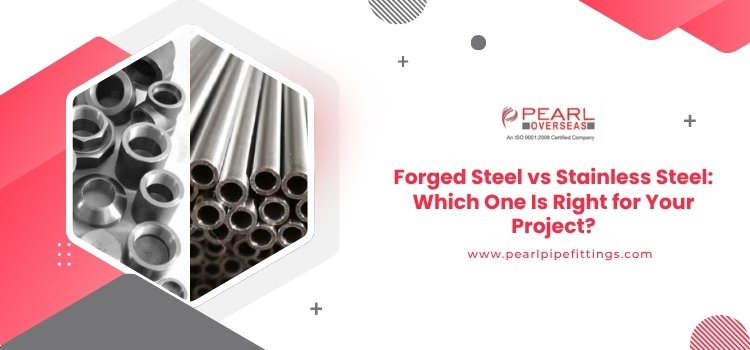
Understanding Forged Steel vs Stainless Steel in Modern Piping
As a procurement, design, or maintenance professional working in an industrial piping system, you may have encountered the same question: Forged steel or stainless steel, which do you choose for the next project? Forged Steel vs. stainless steel is a recurring topic of discussion among engineers and purchasing managers, as both materials are durable, dependable, and reliable, and are used in pipelines, refineries, and process plants. Yet they behave very differently under pressure, heat, and corrosive conditions.
This guide explains what each material is, their relative strength and costs, and which is suitable for particular piping applications. By the end, you will have a clear framework for making the right call on your next order.
What Is Forged Steel?
Forged Steel is manufactured by shaping heated metal under high pressure through hammers, presses, or dies. This helps align the metal’s internal grain structure, which is why forged pieces are extremely strong and can withstand shock loads.
Forged Steel fittings, such as elbows, tees, and couplings, are commonly used in high-pressure and high-temperature piping systems. The forging process eliminates internal voids and enhances the grain flow, thus enabling it to withstand sudden pressure changes and mechanical stresses much better than cast counterparts.
- Higher tensile strength due to grain alignment
- Better resistance to fatigue and impact
- Fewer internal defects compared to cast components
- Commonly manufactured in carbon steel, alloy steel, and stainless grades
You can read more about grade-specific forged fitting standards in our post on ASTM A105 vs A105N forged fittings.
What Is Stainless Steel?
Stainless steel is an alloy of iron, chromium, and often nickel or molybdenum. Usually at least 10.5 percent, it creates a thin passive oxide layer on the surface. This layer is responsible for stainless steel’s signature anti-rust and anti-corrosion properties.
Stainless Steel is a family of alloys that may be forged, cast, or machined, whereas Forged Steel is a manufacturing process. This is a crucial difference that is frequently overlooked in the Forged Steel vs Stainless Steel conversation. A component can technically be both forged and stainless at the same time.
Forged Steel vs Stainless Steel: Key Difference
Since Stainless Steel can also be forged, the more useful comparison is usually between forged carbon or alloy steel and forged Stainless Steel. Here is how they stack up across the factors that matter most to engineers and buyers.
| Factor | Forged Carbon/Alloy Steel | Forged Stainless Steel |
| Corrosion resistance | Low, needs coating or lining | High, due to chromium oxide layer |
| Strength | Very high, ideal for high-pressure lines | High, slightly lower than alloy steel |
| Cost | Lower raw material cost | Higher raw material and processing cost |
| Temperature tolerance | Good for high-temperature service | Excellent, including cryogenic use |
| Typical use | Oil, gas, power plant piping | Chemical, pharma, food-grade piping |
Strength and Durability
Forged Steel components, including carbon steel, alloy steel and stainless steel, are strengthened by the forging operation. The grain structure conforms to the shape of the part, making it more resistant to cracking under load. Carbon and alloy Forged Steel is still used in high-pressure pipelines for oil and gas, where it is more often used than stainless steel for raw tensile strength.
Corrosion Resistance
This is where Stainless Steel undoubtedly has the upper hand. Standard Forged Steel is subject to rusting in marine conditions, chemicals, and moisture if not coated or lined. Stainless Steel is naturally corrosion-resistant, making it a preferred choice for chemical processing, marine piping, and food or pharmaceutical applications where hygiene and longevity are important.
Cost Considerations
Generally, Forged Steel in carbon or alloy grades is cheaper than Stainless Steel in both raw material and machining. For projects where the piping will be protected from corrosive exposure, carbon Forged Steel offers a more economical option without sacrificing structural performance. While Stainless Steel may have a higher initial price, it can usually save money in maintenance and replacement costs.
Applications in Piping Systems
Carbon Steel and alloy fittings are used in power generation, oil and gas transportation, and structural piping where the primary concern is mechanical strength. However, stainless steel is the benchmark for other materials in industries where resistance to corrosion and cleanliness are paramount, such as pharmaceuticals, food processing, and offshore installations. If you want to learn more about why stainless steel pipe fittings matter in high-pressure applications, keep reading.
Which One Should You Choose?
The correct answer will depend on your operating conditions. When the piping system will be exposed to aggressive chemicals, moisture, or high hygiene demands, it is worth the extra cost to use Stainless Steel. Forged Steel carbon or alloy steel is often the better choice if you’re looking for maximum strength at a lower cost and the environment is reasonably dry or protected.
Flange type is also an important consideration for many engineers. If that’s on your plate, our guide on “flange vs slip-on flange selection” can help narrow it down for you.
Technical guidance on material standards is provided by ASTM International, which provides references for most of the forged and stainless piping grades referenced, and the ASM International materials database provides further reference on the performance of the alloys.
Conclusion
The difference between Forged Steel and Stainless Steel isn’t necessarily one of the better or worse materials. It’s just about matching material properties to an operating environment. Forged Steel provides excellent raw strength and low cost, which is perfect for high-pressure, non-corrosive service. The corrosion resistance and hygiene characteristics of Stainless Steel make it the most expensive choice, but well worth it for chemical, marine, and food-grade uses. Understanding this Forged Steel vs Stainless Steel distinction upfront helps engineers and purchasing teams avoid costly material mismatches down the line.
FAQs
Q1. Can Stainless Steel also be forged?
Yes. Forging is a manufacturing process, not a material type, and 316L Grade Stainless steel fittings can be forged like carbon/fasteners steel or alloy steel to enhance strength and grain structure.
Q2. Which is stronger, Forged Steel or Stainless Steel pipe fittings?
Forged carbon steel and alloy steel fittings tend to be stronger than forged Stainless Steel, but for any pressure or high-temperature load, Stainless Steel products remain strong.
Q3. Is Stainless Steel always more expensive than Forged Steel?
In most cases, yes. Stainless Steel is more expensive because of the addition of alloying elements (such as chromium and nickel), but it can often result in reduced long-term maintenance and replacement costs because of reduced corrosion.
Need help selecting the right Forged Steel vs Stainless Steel fittings for your piping system? Contact our technical team at export@pearlpipeindia.com for grade recommendations, pricing, and export support.