
Different Types of Pipe Fittings and Their Uses in Industries
Usually, when plumbing or any industrial piping system is mentioned, the pipes themselves come to mind. However, pipe fittings play a massive role in ensuring these systems function correctly. From controlling the direction of water and gases to connecting pipes of different sizes and regulating system pressure, it is all done by the right fitting. In this guide, we will explore the various types of pipe fittings, their designated purposes, relevant industrial standards, and how to select the fitting that best suits your engineering needs.
Types of Pipe Fittings and Their Uses
Industrial pipe fittings come in various shapes, sizes, and materials, each designed for particular applications and flow conditions. Below, we detail the core categories of fittings used across modern processing plants, pipelines, and refineries.
-
Elbow Fittings (ASME B16.9 / ASME B16.11)
Elbow fittings permit pipes to change direction. They do so at various angles, normally 90-degree and 45-degree bends, to route pipelines around structures and obstacles.
- 90-Degree Elbow: These fittings are used to turn a pipeline horizontally or vertically. For high-pressure systems, forged carbon steel elbows conforming to ASME B16.11 are preferred, while butt-weld designs align with ASME B16.9.
- 45-Degree Elbow: Ideal for gentle turns, these fittings minimize turbulence and friction loss, making them highly beneficial when designing a gradual slope in drainage systems or process lines.
-
Tee Fittings (ASME B16.9 / ASME B16.11)
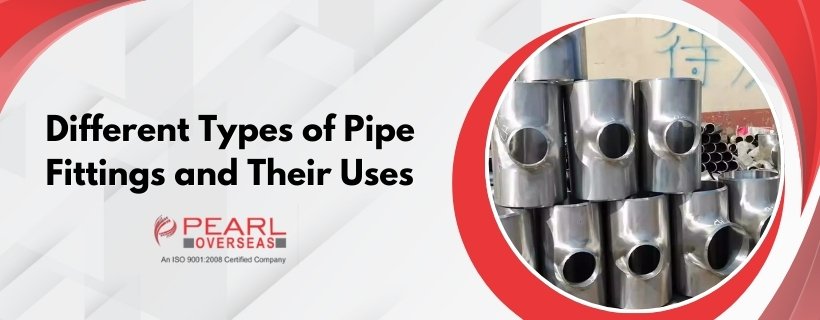
Tee fittings are shaped like the letter ‘T,’ allowing three connecting pipes at one junction. They are crucial for branching off a main line to create sub-branches.
- Standard Tee: Features equal run and branch sizes, used in piping networks to connect a branch line of the same diameter.
- Reducing Tee: Connects pipes of varying diameters. It is often used where a smaller line branches out from a larger header pipe. High-alloy versions, like Super Duplex steel tees, are extensively used in desalination and offshore projects to handle aggressive media.
-
Reducers (Concentric vs. Eccentric)
Reducers are critical for changing the pipe size to adjust the flow rate or connect pipes of different diameters. They generally fall under the ASME B16.9 butt-welding standard.
- Concentric Reducers: Shaped like a cone, concentric reducers share a common centerline. They are primarily used in vertical piping runs to maintain alignment.
- Eccentric Reducers: Features one flat side, shifting the centerline of the pipe. They are essential in horizontal suction lines for pumps to prevent air pockets from forming, which could lead to pump cavitation. For harsh chemical environments, Hastelloy reducers or SMO 254 reducers are frequently specified.
-
Flanges (ASME B16.5)
Flanges are used to connect pipes, valves, pumps, and other piping components, enabling easy access for cleaning, inspection, or modifications. They are bolted together with a gasket between them to ensure a leak-proof seal. Key styles include:
- Weld Neck Flanges: Feature a tapered hub that butt-welds to the pipe, offering excellent strength under extreme pressures and temperatures.
- Slip-On Flanges: Slipped over the pipe and fillet-welded, ideal for lower-pressure systems.
- Socket Weld Flanges: The pipe inserts into a socket before welding, widely used in small-bore, high-pressure piping. You can explore specialized material options on the dedicated Stainless Steel Flanges product page.
- Blind Flanges: Solid disks used to seal the end of a piping run or pressure vessel nozzle.
-
Couplings and Unions (ASME B16.11)
These fittings are designed to join two pipe sections together, commonly used in small-diameter threaded or socket-weld systems.
- Full Coupling: A straightforward connector used to join pipes of the same size.
- Reducing Coupling: Similar to a full coupling, but joins pipes of varying diameters. High-fatigue areas often employ forged Monel couplings to handle severe pressures and temperatures.
- Unions: Unlike couplings, unions feature a three-piece design that allows easy disconnection of pipes without turning the pipes themselves. They are essential for maintenance or repair purposes, especially near valves and equipment.
-
Caps and Plugs
These fittings are used to seal the ends of pipes and close a piping system. While they perform similar functions, they have distinct structural differences:
- Pipe Caps (ASME B16.9): Fit over the outside diameter of a pipe end (female connection). They protect the pipe end and close the line, and can be butt-welded or threaded. For critical offshore structures, corrosion-resistant Titanium caps are often used.
- Pipe Plugs (ASME B16.11): Fit into a female-threaded fitting or opening (male connection). Plugs thread directly into the pipe end or fitting to provide a temporary or permanent pressure-tight seal.
-
Nipple Fittings (ASME B16.11)
A nipple fitting is a short length of pipe with male threads at both ends (or one end plain) used to connect two female-threaded fittings or valves.
- Close Nipple: Threaded close to the center with minimal space between the connected fittings.
- Long Nipple: Offers a longer unthreaded section for adjustable placement and precise spacing in complex headers.
Key Manufacturing Standards for Pipe Fittings
To ensure high quality, pressure safety, and global compatibility, industrial pipe fittings must align with recognized standards. The two most prominent are:
- ASME B16.9: The standard for factory-made wrought butt-welding fittings. It covers dimensions, ratings, and testing for elbows, tees, reducers, and caps of larger sizes.
- ASME B16.11: The standard for forged fittings, covering both socket-welding and threaded styles. This applies to small-bore, high-pressure fittings like forged couplings, elbows, tees, unions, plugs, and nipples.
Comparison of Common Pipe Fitting Types
Understanding the standard connections and typical uses helps engineers specify the correct fitting. The table below lists the comparison points:
| Fitting Type | Connection Method | Applicable Standards | Primary Industrial Application |
|---|---|---|---|
| Elbow (90° / 45°) | Butt-weld, Socket-weld, Threaded | ASME B16.9 / B16.11 | Changing pipeline flow direction around obstacles |
| Tee (Equal / Reducing) | Butt-weld, Socket-weld, Threaded | ASME B16.9 / B16.11 | Branching a single process line into multiple lines |
| Reducer (Concentric / Eccentric) | Butt-weld | ASME B16.9 | Changing pipe sizes; eccentric used at pump suction to avoid cavitation |
| Flange | Bolted joint (welded to pipe) | ASME B16.5 / B16.47 | Connecting pipes to valves, pumps, and inspectable equipment |
| Coupling / Union | Socket-weld, Threaded | ASME B16.11 | Joining pipe segments; unions allow easy maintenance disassembly |
| Cap / Plug | Butt-weld, Threaded | ASME B16.9 / B16.11 | Dead-ending or sealing pressure lines and fittings |
| Nipple | Threaded, Plain-end | ASME B16.11 | Connecting female-threaded components and instrument lines |
Choosing the Right Pipe Fittings
Selecting the correct industrial fittings requires evaluating several guiding parameters:
- Material Compatibility: Ensure the fitting material matches the pipe material (e.g., matching a duplex pipe with duplex fittings) to avoid galvanic corrosion and ensure thermal expansion compatibility.
- Pressure Ratings: Fittings are rated by schedule (for butt-welds) or pressure class (e.g., Class 2000, 3000, 6000, or 9000 for forged ASME B16.11 fittings). Choose a class that supports your maximum system pressure.
- Temperature Resistance: Some materials (like carbon steel ASTM A105) lose ductility at low temperatures, while others (like stainless steels and titanium alloys) maintain strength in cryogenic and ultra-high-temperature environments.
- Installation Type: Select the connection type (butt-weld for permanent, leak-proof large lines; socket-weld for small high-pressure lines; threaded for low-pressure non-critical lines; bolted flanges for maintenance access points).
Conclusion
Understanding different types of pipe fittings and their uses is essential for anyone working in plumbing, industrial construction, or chemical processing. Specifying the correct fittings ensures optimal performance, minimizes pressure drops, prevents leaks, and guarantees long-term system integrity. Whether you are dealing with carbon steel utility lines or high-performance superalloy processing loops, using high-quality components is non-negotiable.
Frequently Asked Questions (FAQs)
Q1. What are some of the most prevalent pipe fittings to use in the industrial context?
The most common industrial pipe fittings include elbows, tees, reducers, unions, flanges, caps, plugs, nipples, and couplings. These fittings assist in the control of flow direction, connection of pipe sections, adjustment of pipe sizes, and overall system functionality.
Q2. What material is the most appropriate in high-corrosion conditions?
Stainless steel fittings, particularly grades 304 and 316, provide excellent corrosion resistance. For highly aggressive or specialized corrosive conditions, high-performance alloys such as Duplex, Super Duplex, Hastelloy, Monel, SMO 254, and Titanium are highly recommended.
Q3. What is the correct selection of the grade of pipe fittings?
Selection should depend on the operating pressure, temperature range, and type of fluid. Carbon steel grades like ASTM A105 and A234 WPB are selected for high-pressure and high-temperature utility lines, whereas stainless and alloy steel grades are chosen for corrosive chemical services.
Looking for premium, high-quality industrial fittings and flanges? Pearl Pipe Fittings is your trusted manufacturer and exporter in India. We offer a comprehensive catalog of fittings designed to match your industry’s exact specifications. Email us at export@pearlpipeindia.com or contact Pearl Pipe Fittings today to request a quote or discuss your project needs!