
Understanding Reducers in Industrial Piping Systems
Even the smallest pipe fitting in a large-scale industrial piping system can have a massive impact on flow efficiency, safety, and long-term maintenance. When connecting pipes of different diameters, engineers rely on a specific type of fitting known as a pipe reducer. The two most common types specified in modern infrastructure are the Concentric Reducer vs Eccentric Reducer.
Understanding the difference between concentric vs eccentric reducers is critical for construction heads, architects, and piping contractors designing systems for commercial buildings, oil and gas platforms, or chemical processing plants. Choosing the wrong pipe reducer type can result in severe flow issues, including the accumulation of fluid, air pockets, violent vibrations, and eventual pump failure.
This guide breaks down the design differences, functionality, key applications, and practical selection criteria for both reducer types. By knowing exactly when to use an eccentric reducer versus a concentric one, you can ensure safer installations, optimized flow rates, and strict adherence to engineering best practices.
What Is a Concentric Reducer?
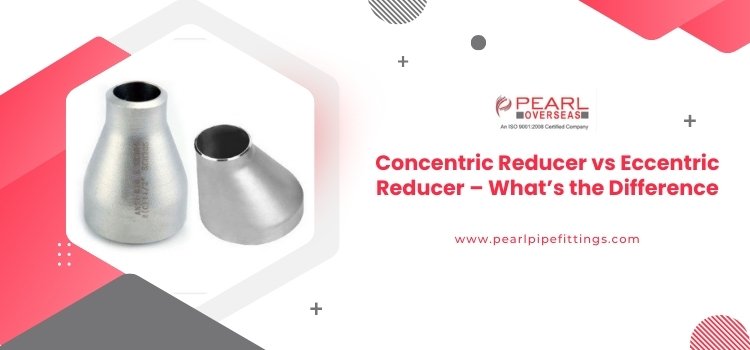
A concentric pipe reducer is a symmetric fitting used to join a larger pipe to a smaller pipe while keeping the centerlines of both pipes perfectly aligned. Because it decreases in diameter uniformly, it typically features a symmetrical, cone-shaped design.
Key features of concentric reducers:
- Centerlines of the joined pipes remain perfectly aligned.
- Uniform, symmetrical reduction in the pipe’s diameter.
- Cone-shaped physical design.
- Engineered specifically for vertical pipe installations.
Typical Applications of Concentric Reducers
Concentric reducers provide controlled, balanced flow transitions and are highly recommended in the following scenarios:
- Vertical piping runs where fluid flows upwards or downwards.
- Systems where even distribution of stress and pressure is required.
- Discharge sides of pumps where air accumulation is not a major concern.
Industries such as power generation, chemical processing, and wastewater treatment rely heavily on concentric pipe fittings to maintain balanced pressure transitions.
What Is an Eccentric Reducer?
An eccentric pipe fitting also connects pipes of two different diameters, but its design is notably asymmetrical. Instead of aligning via a shared center axis, the centerlines are offset. One side of the fitting is completely flat (either the top or bottom edge), preventing unwanted air or fluid from getting trapped in the line.
Key features of eccentric reducers:
- Asymmetrical design with offset centerlines.
- One perfectly flat edge (flat-on-top or flat-on-bottom configuration).
- Actively prevents the buildup of trapped air pockets and pooling liquids.
- Specifically designed for horizontal piping runs.
Typical Applications of Eccentric Reducers
Knowing exactly when to use an eccentric reducer is vital for system longevity. They are the standard choice for:
- Horizontal pipeline installations.
- Pump suction lines (typically installed flat-on-top).
- Systems requiring strict venting or continuous fluid drainage.
You will frequently find eccentric reducers in oil and gas pipelines, petrochemical refineries, complex HVAC chilled water systems, and specifically near pumps and compressors to prevent destructive cavitation.
Concentric vs Eccentric Reducer: The Key Differences
Making the right engineering decision comes down to understanding the practical differences between these two industrial pipe fittings.
1. Design and Alignment
- Concentric Reducer: Symmetrical, cone-shaped design with perfectly aligned centerlines.
- Eccentric Reducer: Asymmetrical design with offset centerlines and one flat edge.
2. Flow Behavior and Vapor Traps
- Concentric Reducer: Can trap air pockets if used horizontally with liquids.
- Eccentric Reducer: The flat side prevents air pockets and liquid pooling, ensuring uninterrupted flow.
3. Installation Orientation
- Concentric Reducer: Best suited for vertical pipe installations.
- Eccentric Reducer: Mandatory for horizontal pipe installations.
Why Proper Reducer Selection Matters
For engineers and contractors dealing with massive commercial projects, selecting the appropriate pipe reducer goes beyond basic plumbing—it determines the overall performance and safety of the infrastructure.
Risks of Poor Selection:
- Turbulent flow and massive flow inefficiency.
- Heightened maintenance and replacement costs.
- Severe cavitation damage to expensive pump impellers.
- Critical safety risks to the entire industrial system.
Benefits of Correct Selection:
- Smooth, laminar fluid flow.
- Extended lifespan for pumps and adjoining equipment.
- Strict adherence to ASME and industrial piping codes.
Conclusion
In summary, understanding the nuances of an eccentric vs concentric reducer is an unavoidable necessity for anyone involved in piping design and infrastructure planning. A concentric reducer operates beautifully in vertical pipelines where symmetry and balanced stress are needed. Conversely, eccentric reducers are the absolute standard for horizontal piping—especially near pump suctions—because their flat-edge design eliminates dangerous air pockets and destructive cavitation.
FAQs
Q1. Which is better: a concentric or an eccentric reducer?
Neither is inherently “better”; it entirely depends on the installation orientation. A concentric reducer is heavily favored in vertical systems for symmetrical flow. However, horizontal pipelines—especially those interacting with pump suction—require an eccentric reducer to eliminate air pockets and maintain fluid velocity. Choosing the correct fitting enhances system efficiency and slashes maintenance risks.
Q2. Why are eccentric reducers used in pump suction lines?
Eccentric reducers are installed (usually flat-side up) on pump suction lines to prevent air from stagnating at the top of the horizontal pipe. If air pockets enter the pump, it causes cavitation—a phenomenon that triggers violent vibrations and destroys the pump’s internal mechanics. An eccentric reducer ensures a constant, solid stream of fluid reaches the pump, preventing this damage.
Q3. Can concentric reducers be used in horizontal pipelines?
While physically possible, using concentric reducers in horizontal liquid pipelines is highly discouraged by engineering standards. Their symmetrical, cone-like shape naturally creates a high point where trapped air or vapor bubbles accumulate. Over time, these pockets disrupt flow and cause system inefficiency. In horizontal scenarios, eccentric reducers are always the preferred choice.
The choice between a concentric vs eccentric reducer plays a critical role in pipeline performance and safety. Ready to upgrade your project’s efficiency with premium materials? Contact us today or email us at export@pearlpipeindia.com to get expert guidance and reliable industrial piping solutions perfectly tailored to your construction needs.