
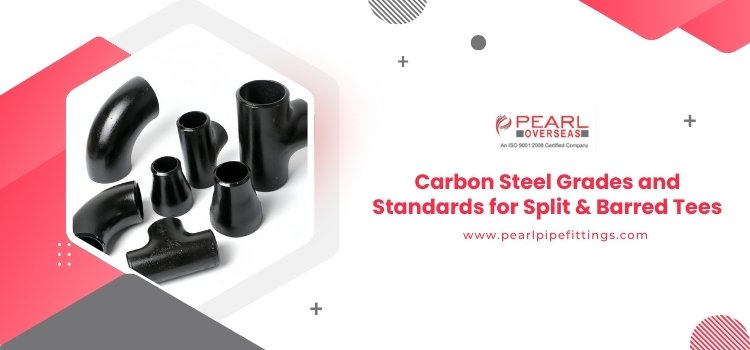
Understanding Material Selection for Reliable Piping Connections
The choice of material is a decisive one in the industrial piping system, particularly regarding safety, durability, and long-term operation. Split and barred tees are commonly deployed in the construction, oil and gas, power and process industries in terms of branch connections and distribution of flows. Knowledge of Carbon Steel Grades and Standards for Split and Barred Tees assists project heads, architects and contractors in compatibility with pressure ratings, temperature restrictions and existing applicable codes.
Carbon steel is still one of the most desirable materials to use in these fittings because of its strength, weldability and ability to cost less. The different grades and standards are specifically to suit different service requirements, either low-pressure utility lines or high-pressure industrial pipelines. It is critical to know the grades that correspond to which standard so that overengineering, premature failure, or non-compliance during inspection will be avoided.
Why Carbon Steel Is Preferred for Split & Barred Tees?
Carbon steel is also commonly applied in piping elements due to the fact that it provides a reasonable balance between mechanical strength and financial feasibility. In relation to the Carbon Steel Grades and Standards of Split and Barred Tees, this material assists in the integrity of the structure and simplicity of fabrication.
Key advantages include:
- Stress tensile and yield Pressure handling.
- Good machinability and welding ability.
- Access to more than one international standard.
- Economical in use as compared to alloy steels.
All these advantages render carbon steel split tees and barred tees the right choice in large-scale construction and infrastructure projects.
Common Carbon Steel Grades Used for Split & Barred Tees
The most important concerns the selection of the appropriate grade that is used in the Carbon Steel Grades and Standards of Split and Barred Tees. Every grade is characterized by chemical composition and mechanical characteristics.
ASTM A105 Carbon Steel Grade
ASTM A105 is a grade of forged carbon steel fitting that is mostly used.
- High-pressure and high-temperature serviceable.
- Commonly employed in power plants, oil and gas.
- Powers well and is very strong.
Split tees and barred tees that are used in critical piping networks are often given this grade.
ASTM A234 WPB Grade
ASTM A234 WPB is also an option for wrought carbon steel fittings.
- Applied medium temperature and pressure settings.
- Usually found in refineries, petrochemical plants and pipelines.
- Applicable to different welding.
The grade is often used where performance and cost must be in line.
ASTM A350 LF2 Grade
ASTM A350 LF2 is a good option when a low-temperature is required.
- Engineered to withstand impact even in sub-zero temperatures.
- Applicable in low temperatures and cryogenic applications.
- Does not lack strength, but remains non-brittle.
The addition of this grade enlarges the Applicability of the Carbon Steel Grades and Standards of Split and Barred Tees to some special conditions.
International Standards Governing Split & Barred Tees
Standards are used to measure the dimensional accuracy, test requirements and performance standards. Knowing these standards would guarantee compliance and safety.
ASME Standards for Piping Components
The industrial piping systems extensively use ASME standards.
- stipulate pressure-temperature ratings.
- Design specifications and testing specifications.
- Bring about interchangeability and reliability.
Split and barred tees are ASME-made, which are relied on for critical services.
MSS and Dimensional Standards
Consistency is maintained with the help of the manufacturer’s Standardization Society (MSS) guidelines.
- Dimensions and tolerances of covers.
- Make sure that it fits with pipes and other fittings.
- Uniform quality among the suppliers.
These standards are in addition to material specifications in Carbon Steel Grades and Standards in Split and Barred Tees.
Applications of Carbon Steel Split & Barred Tees in Construction
To the construction heads and contractors, knowing grades is not equally important as knowing applications.
Typical uses include:
- Branch hookups in high-pressure pipelines.
- Flow control systems and distribution systems.
- Industrial building structural and utility piping.
In constructions where stability and legal standards are needed, architects and engineers tend to use carbon steel fittings.
How to Choose the Right Carbon Steel Grade and Standard?
The decision on which option to choose among the available Carbon Steel Grades and Standards for Split and Barred Tees depends on the project requirements.
Take into consideration the following factors:
- Pressure, working pressure, and temperature.
- Exposure to the environment (corrosive or non-corrosive).
- Relevant industry codes and specifications of the client.
- The inspection and certification conditions.
An appropriate selection will lower the maintenance expenses and enhance system reliability.
Conclusion
To sum up, knowledge of the Carbon Steel Grades and Standards for Split and Barred Tees is key to the development and implementation of safe and efficient piping systems. There are common grades, such as ASTM A105 and ASTM A234 WPB, and low-temperature grades, such as ASTM A350 LF2, and each of these grades has its purposes. Standards like ASME and MSS provide uniformity, safety, and compliance between projects. Informed material selection will provide stronger systems, fewer failures, and long-term confidence in the operations to construction heads, architects and contractors.
FAQs
Q1. Which carbon steel grade is most commonly used for split tees and barred tees?
The most common types of carbon steel used are ASTM A105 and ASTM A234 WPB, as they are strong and available and meet the common piping requirements.
Q2. How do standards help in selecting carbon steel split tees?
Material properties, pressure ratings and testing methods are all governed by standards which make sure that split tees and barred tees can perform to the expectations and with regard to safety.
Q3. Are carbon steel barred tees suitable for high-pressure applications?
Yes, barred tees can be used in high-pressure and high-temperature services when made of correct grades and standards of carbon steel.
Ready to specify the right Carbon Steel Grades and Standards for Split & Barred Tees for your next project? Contact us today to get expert guidance, ensure compliance, and source reliable piping components. Email us at export@pearlpipeindia.com and build with confidence.