
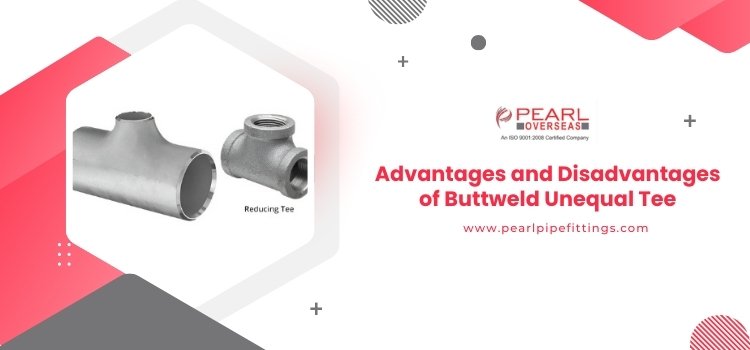
Understanding the Structural Role of Unequal Tee Fittings in Piping Systems
In complex piping networks of large-scale construction, refineries, power plants, and business buildings, the choice of the right fitting is not merely a technical one; it can be a strategic one. The Advantages and Disadvantages of Buttweld Unequal Tee are especially significant when different pipe diameters and pressure levels are involved. A buttweld unequal tee joins three pipes, with the branch pipe sized between the main run, so that fluid distribution can be regulated without damaging system integrity.
For construction heads, architects, and contractors handling high-value infrastructure, it is straightforward to determine how these fittings perform under real-world conditions to reduce long-term operational risks. Although buttweld fittings are known to be strong and allow free flow, they also have installation and maintenance issues associated with them. Assessment of systems and restrictions of the piping system is a guarantee of an efficient, durable, and cost-effective system.
Advantages and Disadvantages of Buttweld Unequal Tee in Detail
A buttweld unequal tee is especially convenient when a branch line is smaller or intended to be smaller than the main pipeline. But just as any special fitting, it also has strong and weak points.
Major Advantages
Flexible Design Integration
Efficient Space Utilization
Reduced Joint Count
High Structural Stability
It enables the interconnection of pipes of dissimilar dimensions without the utilization of numerous reducers.
Ideally suited to a small space mechanical room or an industrial plant.
The reduced number of additional fittings results in reduced points of leakage.
Applicable to heavy-duty systems of commercial buildings and processing plants.
All of the above strengths allow the Advantages and Disadvantages of Buttweld Unequal Tee to serve an essential purpose to engineers involved in conducting massive building services and utilities.
Advantages of Buttweld Fittings in Industrial Projects
In evaluating the advantages of buttweld fittings, structural integrity and take-things performance are the first to be mentioned. These fittings are welded into the pipe, forming a permanent and strong bond.
Key benefits include:
High Strength and Durability
Smooth Flow Characteristics
Long Service Life
Better Load Distribution
Buttweld fittings are a continuous metal structure; they are suitable for high-pressure and high-temperature conditions.
The inside surface is nearly smooth, causing less turbulence and pressure drop.
When the fittings are properly welded, they are less likely to leak than the threaded or socket-weld connections.
This in heavy industrial construction makes the stress evenly spread throughout the system.
These benefits of buttweld fittings translate into improved operational reliability and reduced downtime in the case of large infrastructure projects.
Disadvantages of Buttweld Pipe Fittings
The performance is also good, but it is also important to know the disadvantages of buttweld pipe fittings before specifications are finalized.
Some limitations include:
Higher Installation Cost
Permanent Joint
Inspection Requirements
Heat-Affected Zone Risks
Proficient welding services and inspection escalate startup costs.
Welding has to be cut and re-welded once it is made.
Non-destructive testing (NDT) is used to test the quality of most of the welds.
Bad welding will cause material weakness around the joint.
For contractors, the drawbacks of welded pipe fittings can affect each project and schedule of budgetary projections, particularly in retrofit projects.
What Is the Difference Between Inequality and Equality in Tee?
Comparing the unequal tee and equal tee, the major difference is seen mostly in the configuration of the pipe size.
- Equal Tee: The diameter of all three outlets is equal.
- Unequal Tee: The branch run differs in diameter from that of the main run.
The decision between an unequal tee vs equal tee will depend on:
- Distribution flow requirements.
- Management of the pressure plan.
- Space constraints.
- Design efficiency.
Unbalanced tees in large commercial buildings or industrial systems reduce the number of reducers required and therefore provide a clearer, more efficient layout.
Problems with Unequal Tee Fittings in Certain Conditions
They have issues with unequal tee fittings that can cause problems if they are not designed or installed properly.
Potential issues include:
Flow Imbalance
Stress Concentration
Welding Complexity
Maintenance Challenges
Poor sizing may result in an uneven pressure distribution.
Transits in size can cause stress in localities.
Needs accuracy to achieve alignment and joint strength.
Unlike mechanical fittings, replacement is more complex.
Such issues of disproportionate tee fittings can normally be avoided by making the right engineering calculations and certifications of the welding work.
Conclusion
To sum up, the Advantages and Disadvantages of butt-weld unequal tee shows the significance of the informed choice of the material and design when working on large-scale construction and industrial projects. That buttweld fittings are of superior strength, leak-proof and have a long service-life is an added advantage. Nonetheless, such downsides of welded pipe fittings as increased costs of installation and permanently welded joints should be taken into account. Knowledge of unequal tee vs equal tee configurations and foresight of the pitfalls that are likely to occur when using unequal tee fittings will lead the architects, contractors, and heads of construction to design safer and more efficient piping systems.
FAQs
Q1. What are the main advantages of buttweld fittings in high-pressure systems?
They are very strong, flow smoothly and can resist leaking in the long run, hence they are applicable in projects of industrial and commercial infrastructure.
Q2. What are common problems with unequal tee fittings in industrial pipelines?
Among the critical issues that need to be thought through include flow imbalance, stress concentration and complexity of installation in case not properly engineered.
Q3. How does unequal tee vs equal tee impact piping design efficiency?
Unequal tees minimize the requirement for more reducers, making system design less complicated when there is a requirement to interconnect between pipe sizes.
Looking to optimize your next industrial or commercial piping project? Know the Benefits and shortcomings of Buttweld Unequal Tee before settling your specifications and refer with knowledgeable piping experts on the performance, safety and value in the long run. Get in touch with us and address your project needs.