
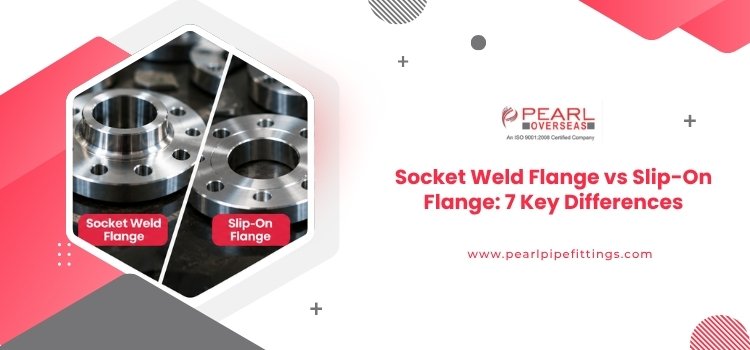
Why Does the Right Flange Choice Matter?
On paper, it seems simple to choose between a socket weld flange vs slip-on flange. They both fit on the pipe, both are fillet welded, and both are covered by the same standard. In fact, it has an impact on joint strength, installation time, inspection work and long-term reliability.
In this guide, we will be discussing socket weld flange vs slip-on flange in 7 practical points. If you are an engineer, site supervisor or procurement specialist, it will help you specify the right flange the first time and avoid costly rework. Both types fall under ASME B16.5 flanges, the standard that covers dimensions, ratings and tolerances for sizes from NPS ½ to 24.
What Is a Socket Weld Flange?
A socket weld flange has a recessed bore or “socket” into which the end of the pipe fits. The pipe stops against an internal shoulder and is then pulled back about 1.6 mm (1/16 inch) before welding. A single fillet weld around the outside completes the joint.
This small gap allows for the pipe and weld to expand without cracking. These flanges have been designed for small-bore, high-pressure lines and are frequently found on instrument, chemical injection and utility piping.
What Is a Slip-On Flange?
A slip-on flange has a bore slightly larger than the pipe’s outside diameter, which allows it to slide in easily. The flange is then fillet welded twice, once on the outside and once on the inside.
Fit-up is forgiving since the pipe does not have to bottom out on a shoulder. Slip-on flanges are popular in water, utility and fire protection lines. For a related comparison, read our guide on plate flange vs slip-on flange.
Socket Weld Flange vs Slip-On Flange: 7 Key Differences
1. Design and Construction
The socket weld flange has a counterbored socket with a built-in shoulder. The bore of the slip-on flange is plain, and there is no stop, so pipe position is dependent on the fitter’s measurement.
2. Welding Method
A socket weld flange requires one outside fillet weld. A slip-on flange requires two, inside and outside, which requires additional welding time and additional filler metal. The inner weld also leaves a bead in the bore.
3. Size Range
In practice, socket weld flanges are used in small-bore pipes, usually NPS 2 and smaller. These apply to the entire range of ASME B16.5 flanges, up to NPS 24, making them much more suited to larger lines.
4. Socket Weld Flange Pressure Rating and Strength
Both types are manufactured in the pressure classes as specified by ASME B16.5, although the joint behaves differently. A socket weld joint will usually be more durable and leak-free, and is therefore the preferred choice for high-pressure, small-bore service. Slip-on flanges are better kept for lower-pressure, less critical lines. The socket weld flange pressure rating still depends on class, material grade and temperature, so check the pressure-temperature tables for ASME B16.5 flanges before finalising the class.
5. Installation and Alignment
Slip-on flanges can accept rough-cut pipe since the pipe doesn’t have a fixed stop. Socket weld flanges self-align on the shoulder, but the 1.6 mm gap must be adjusted by fitters; otherwise, the residual stress will cause cracking of the weld. Socket weld joints also require a more skilled welder, and slip-on joints fit more quickly.
6. Corrosion, Flow and Inspection
The joints are both fillet welded, making full radiographic inspection impractical. Surface methods such as dye penetrant testing are more common. A gap in a socket weld can hold fluid, which is important for corrosive or hygienic service, and a small gap in the weld of a slip-on flange can slightly affect flow.
7. Cost and Typical Applications
Slips are usually the lower cost option for low to moderate pressure lines, although they require added weld labour. Socket weld flanges are more expensive per joint but are well justified in refineries, chemical plants and power stations where small high-pressure lines are prevalent.
Difference Between Socket Weld and Slip On Flange: How to Choose
The difference between socket weld and slip-on flange comes down to size, pressure and service. For small-bore, high-pressure or vibration-prone lines, choose a socket weld flange. A slip-on flange is the answer for larger, low- to medium-pressure lines where speed and cost are important.
Always check the line class and project specification as well. Forged carbon steel flanges are typically made to ASTM A105, and our discussion of A105 vs A105N describes the difference between the two grades. Deeper background on flange types is provided in the Wermac flange guide, which is an engineering reference.
Conclusion
The socket weld flange vs slip-on flange decision is basically a sizing, pressure and installation decision, and the difference between socket weld and slip-on flange is obvious after you know your line class. Socket weld flanges provide better, leak-free connections in low-diameter, high-pressure lines. Flanges are required for moderate-pressure systems, are easier to fit, and offer a larger size range than slip-on flanges. Confirm the line class, service and material before ordering, and the right flange will be clear.
FAQs
Q1. What is the main difference between a socket weld flange and a slip-on flange?
A socket weld flange has a shoulder and needs one outside fillet weld. A slip-on flange does not have a stop and requires 2 fillet welds.
Q2. Can a slip-on flange be used for high-pressure piping?
Generally, it is not desired. Slip-on joints are more suitable for lower-pressure, less critical service; socket-weld or weld-neck flanges are better for high-pressure service.
Q3. Why is a gap left in a socket weld flange before welding?
The approximate 1.6 mm clearance will allow for thermal expansion and minimize residual stress in the weld, which is also mentioned in this socket weld flange explainer.
Send your flange size, class and material requirement to export@pearlpipeindia.com or visit the Contact Us page.