
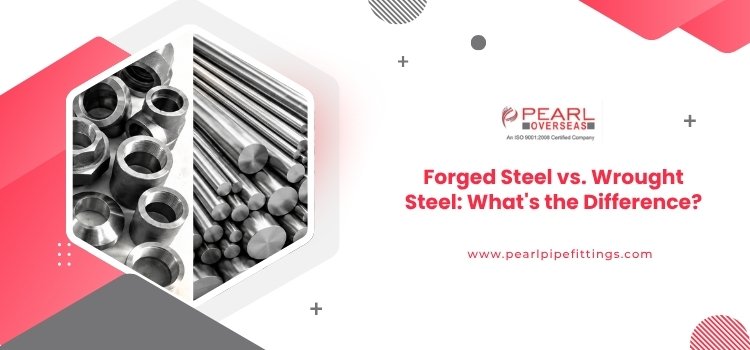
Understanding Forged Steel and Wrought Steel in Industrial Manufacturing
Procurement professionals and design engineers often hear the terms forged steel vs wrought steel, and they’re often confused. The confusion is understandable. They are both built from the same raw material (steel), both formed (not cast), and both appear on the same material specification sheets as pipe fittings, flanges, and structural parts. However, the only difference between Forged Steel and Wrought Steel is how the metal is shaped, and that single difference affects strength, grain structure, and placement on a project. When you are approving materials for a pressure system, a load-bearing structure, and/or an export order, this matters to avoid a costly mismatch. This is a simple breakdown of forged steel vs. Wrought Steel to help you make the right decision on your next order.
Key Takeaways
- Forged steel is the form of steel that is formed by compressive force (hammering or pressing), refining the grain structure and increasing strength.
- Wrought steel is a general term that refers to any steel that has been mechanically shaped (rolled, drawn, extruded, and forged) in place of casting.
- Technically, forging is a subset of the wrought process, and therefore the two are often confused.
- Forged steel generally has the highest tensile strength and fatigue resistance, while wrought steel (rolled/extruded forms) is the most economical and easily formed.
- Deciding on the right choice depends on the pressure rating, load type, budget, and not on which term sounds stronger.
Forged Steel: How It’s Made and Why It’s Strong
Forged steel is steel that has been processed to its final form by heating and then applying compressive forces, either using a hammer, press, or a die. Manufacturers use a few different methods depending on the part:
- Open-die forging for large, simple shapes
- Closed-die forging for precise, repeatable components like flanges and fittings
- Rolled-ring forging for ring-shaped parts such as flanges and bearing races
The difference in forged steel comes from what happens within the material itself during this process. The compressive force aligns the grain flow with the part’s contour and seals internal voids or porosity that may occur in the initial casting. The result is a material that’s denser, tougher, and more fatigue-resistant than other materials, which is why forged steel is used for the most demanding parts, like forged fittings, valve bodies, and flanges, produced to standards like ASTM A105.
Wrought Steel: How It’s Made and Where It’s Used
Wrought steel is a wider umbrella term. It refers to any steel mechanically manipulated into its final form rather than cast in a mold. That includes rolling, drawing, extruding, and yes, forging. For ordinary industrial practice, however, the term “wrought steel” is used exclusively for hot-rolled or cold-rolled products like plates, bars, sheets, and seamless or welded pipe.
The wrought process, or rolling, results in a material that is easier to form into long, continuous shapes and is often more ductile than a heavily forged member. This flexibility allows wrought steel to be used in structural beams, sheet fabrication, butt-welded pipe fittings, and situations where formability and cost matter as much as raw strength.
Forged Steel vs. Wrought Steel: Key Differences
| Factor | Forged Steel | Wrought Steel |
| Process | Shaped under compressive force (hammer/press) | Rolled, drawn, or extruded into form |
| Grain structure | Refined, aligned with part shape | Layered, generally more uniform |
| Strength | Higher tensile strength and fatigue resistance | Strong, but typically lower than forged |
| Ductility | Lower than wrought forms | Higher, easier to bend and shape |
| Typical use | Flanges, valve bodies, high-pressure fittings | Pipes, sheets, beams, structural sections |
| Cost | Generally higher due to processing steps | Generally lower, faster to produce |
Which One Should You Choose for Your Project?
The material you select depends on how the part will be loaded in service. For parts such as flanges and buttweld fittings, which are likely to be subjected to repetitive loading, shock loading, or hot service, forged steel is typically the better choice because of its resistance to fatigue cracking and reduced porosity. Wrought (rolled) steel products are often the most cost-effective and viable option for structural framing, sheet metal construction, or long pipe runs when formability and cost matter more than peak strength.
If you are sourcing carbon steel pipe fittings for either category, it helps to compare grades directly. You can see how forged carbon steel stacks up against stainless alternatives in our post on forged steel vs. stainless steel, and if your specification sheet lists A105 or A105N, our breakdown of the difference between ASTM A105 and A105N covers exactly where those grades diverge.
Conclusion
Forged steel vs. wrought steel are not rival types of steel, but rather overlap; steel forging is just one part of the broader process of steel wroughting. The difference in practice is grain refinement and strength; forged steel is designed for high-stress, high-fatigue applications, while wrought (rolled) steel is formable and suitable for structural and general fabrication applications. Understanding which one your project requires, depending on the pressure, load pattern, and budget, is the only thing that keeps a piping system or structure running as designed.
FAQs
Q1. Is forged steel stronger than wrought steel?
In most cases, yes. This compressive forging process eliminates the internal porosity and enhances tensile strength and fatigue resistance in forged steel compared to rolled (wrought) steel products.
Q2. Is forging considered a type of wrought process?
Yes. Forging is one of the various processes that falls under the broad category of wrought steel, which refers to steel that is not cast. Other processes may include rolling, drawing, and extrusion.
Q3. Can forged steel fittings be used with wrought steel pipe in the same system?
Yes, this is common practice. Forged fittings (flanges, elbows, tees) are often paired with wrought (seamless or welded) pipe in the same piping system, as long as both meet the pressure rating and material specification required by the design.
Our team at Pearl Pipe Fittings can help you match the right forged or wrought steel fitting to your project’s pressure rating and application. Contact us or write to us at export@pearlpipeindia.com for a quote.