
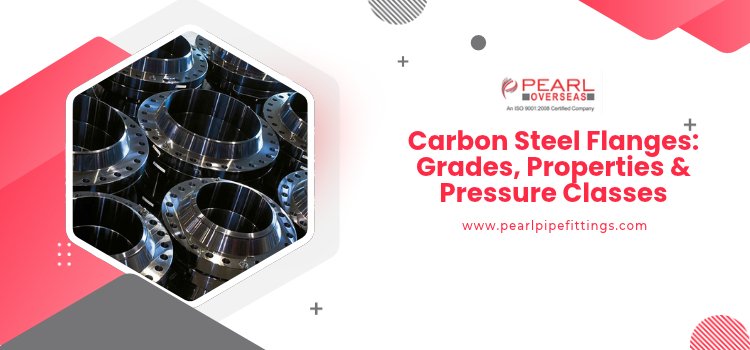
What Are Carbon Steel Flanges and Where Are They Used?
Carbon steel flanges are bolted pipe connections made from forged or plate steel with a controlled carbon content. For ASME-rated piping the standard material is ASTM A105 forgings, chosen for strength, weldability and low cost.
They are used in oil and gas, refineries, chemical plants, power stations, water systems and general construction. They also have limits. Carbon steel rusts without protection, and in standard service it is generally kept below about 800°F (425°C).
This guide covers carbon steel flange grades, mechanical properties, pressure classes, temperature and corrosion limits, and how carbon steel compares with stainless and alloy steel.
Key Takeaways
- ASTM A105 is the standard forged grade for ASME B16.5 flanges. ASTM A350 LF2 is the carbon steel grade for low-temperature service.
- A105 has a minimum yield strength of 36 ksi (250 MPa) and a minimum tensile strength of 70 ksi (485 MPa).
- At ambient temperature an A105 Class 150 flange is rated at 285 psig and a Class 2500 flange at 6,170 psig.
- Carbon steel is strong and low in cost, but it needs a coating or lining against corrosion.
- Choose stainless steel for corrosive service, and alloy steel such as F11 or F22 for hotter lines.
Carbon Steel Flange Grades and Properties
The properties of carbon steel flanges depend on the grade and on whether the flange is forged or cut from plate. Forged flanges (A105 and A350 LF2) cover ASME-rated pressure piping. Plate flanges (A36) are used in non-code, low-pressure service such as waterworks, HVAC and structural connections.
| Grade | Form | Governing Standard | Min Yield | Min Tensile | Typical Service |
|---|---|---|---|---|---|
| ASTM A105 | Forged | ASME B16.5, B16.47 | 36 ksi (250 MPa) | 70 ksi (485 MPa) | General process, oil and gas, steam |
| ASTM A350 LF2 | Forged | ASME B16.5 | 36 ksi (250 MPa) | 70-95 ksi (485-655 MPa) | Low-temperature service |
| ASTM A36 | Plate | AWWA C207 (non-code) | 36 ksi (250 MPa) | 58-80 ksi (400-550 MPa) | Water, HVAC, structural, low pressure |
A105 allows a maximum of 0.35% carbon and 0.60-1.05% manganese. A350 LF2 limits carbon to 0.30% and is impact tested at -50°F (-46°C), which is what makes it suitable for cold service.
Carbon Steel Flange Pressure Classes (ASME B16.5)
Under ASME B16.5, carbon steel flanges are rated by class, and the pressure each class can hold depends on temperature. The table shows A105 (material group 1.1) at -20 to 100°F.
| Flange Class | Max Pressure (psig) | Max Pressure (bar) |
|---|---|---|
| Class 150 | 285 | 20 |
| Class 300 | 740 | 51 |
| Class 600 | 1,480 | 102 |
| Class 900 | 2,220 | 153 |
| Class 1500 | 3,705 | 255 |
| Class 2500 | 6,170 | 425 |
Ratings fall as the temperature rises. A Class 1500 A105 flange is rated at about 2,055 psig at 800°F, against 3,705 psig at ambient temperature. Always read the exact value for your operating temperature from the ASME B16.5 table.
How Hot Can Carbon Steel Flanges Go?
Carbon steel handles moderate to high temperatures, but not unlimited heat. A105 flanges are generally used up to about 800°F (425°C). Above that, prolonged exposure risks creep and graphitization, so alloy steel flanges such as F11 or F22 are specified instead.
Cold service is the other limit, because carbon steel loses toughness at low temperature. A350 LF2 flanges are impact tested for that duty. Match them with low-temperature fittings such as ASTM A420 WPL6 pipe fittings.
Corrosion Resistance and Protection
Carbon steel is not corrosion resistant on its own. It rusts in moisture, seawater and many chemicals, so it is normally protected. Common options are paint or epoxy coatings, galvanizing and internal linings, together with a corrosion allowance in the design.
Where the fluid is highly corrosive, stainless or alloy flanges are the better choice.
Carbon Steel vs Stainless Steel vs Alloy Steel Flanges
| Property | Carbon Steel (A105) | Stainless Steel (F304, F316) | Alloy Steel (F11, F22) |
|---|---|---|---|
| Strength | High | Medium | High to very high |
| Corrosion resistance | Low, needs coating | High | Moderate |
| Temperature use | Up to about 800°F (425°C) | Wide range | High-temperature steam |
| Cost | Low | Medium to high | Medium to high |
| Typical use | Oil and gas, steam, water | Chemical, marine, food | Power plant steam lines |
Carbon steel has a higher minimum yield strength than 304 and 316 stainless at a lower cost, but it cannot match stainless for corrosion resistance. If your line carries corrosive media, look at stainless steel flanges.
Types of Carbon Steel Flanges
ASME B16.5 flanges are made in several types, and each suits a different duty:
- Weld neck: the standard choice for high pressure and high temperature.
- Slip-on: easier to align and lower in cost, used at lower pressures.
- Blind: closes the end of a line, valve or nozzle.
- Socket weld: suits small-bore, high-pressure lines.
- Threaded: used where welding is not practical.
- Lap joint: used with a stub end for lines that are dismantled often.
Applications of Carbon Steel Flanges
Oil and Gas
Flow lines, transmission pipelines and refineries use forged A105 flanges, with A350 LF2 where the line sees low temperatures.
Power and Steam
Boilers and steam lines use carbon steel flanges within their temperature limits. Hotter lines move to alloy steel.
Chemical and Petrochemical Processing
Process lines carrying non-corrosive fluids, or fluids handled with a lining or coating, use carbon steel for its strength and low cost.
Water, HVAC and Construction
Municipal water mains normally use plate flanges to AWWA C207, protected by coatings or linings. Carbon steel flanges also join HVAC networks, fire protection lines and structural piping.
What to Check Before You Order
- Grade and standard: forged A105 or A350 LF2 to ASME B16.5, or plate to AWWA C207.
- Pressure class, size and facing (raised face or ring type joint).
- Operating temperature and pressure.
- Coating or lining for corrosion protection.
- Mill test certificates (EN 10204 3.1) and grade marking on the flange.
- Matching carbon steel pipe fittings for the rest of the line.
Conclusion
Carbon steel flanges are a strong, low-cost choice for most industrial piping, provided you stay within their temperature and corrosion limits. Pick the grade for the service (A105 for general use, A350 LF2 for cold), read the pressure class for your operating temperature, and protect the flange against corrosion. For corrosive or very hot lines, move to stainless or alloy steel.
FAQs
What is the difference between A105 and A350 LF2 carbon steel flanges?
Both are forged carbon steel flanges with the same minimum yield strength of 36 ksi. A105 is the general-purpose grade, used up to about 800°F (425°C). A350 LF2 has a tighter carbon limit and is impact tested at -50°F (-46°C), so it is used for low-temperature service.
Can carbon steel flanges be used in high-temperature applications?
Yes, within limits. A105 carbon steel flanges are generally used up to about 800°F (425°C), and their pressure ratings fall as temperature rises. Above that range, alloy steel flanges such as F11 or F22 are specified.
Are carbon steel flanges corrosion resistant?
Not on their own. Carbon steel rusts in moisture and many chemicals, so it needs coatings, galvanizing or linings. For highly corrosive service, stainless steel flanges are the better choice.
Need carbon steel flanges to ASME B16.5? Send your grade, class, size and facing details through the contact page or email export@pearlpipeindia.com to request a quote from Pearl Pipe Fittings.