
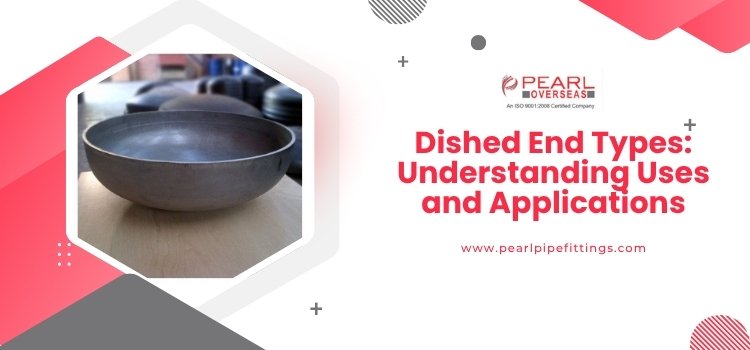
What Are Dished Ends and Why Do They Matter?
A dished end, also called a tank end or vessel head, is a curved steel plate welded to the ends of a pressure vessel or storage tank to seal it and hold internal pressure. The curve matters because a flat plate under pressure has to resist that load through bending alone, while a curved shape spreads the same load through the material as tension, which is far more efficient. That difference is why the specific dished end type you choose has a direct impact on the wall thickness, weight, and cost of the finished vessel.
Dished ends are essential in the processing of chemicals, oil and gas, foodstuffs, and pharmaceuticals because of their strength and their capacity to evenly distribute pressure.
Common Dished End Types Used in Industry
There are five dished end types used across most industrial pressure vessels and storage tanks. Each represents a different tradeoff between strength, material cost, and how difficult the shape is to form.
| Type | Shape | Relative Strength | Relative Cost | Typical Use |
|---|---|---|---|---|
| Hemispherical | One-half of a complete sphere | Highest. Requires roughly half the thickness of a cylindrical shell at the same pressure and diameter. | Highest. Deep-drawing a full hemisphere is the most difficult and expensive forming process. | High-pressure vessels, reactors, spherical storage |
| Ellipsoidal (2:1) | Elliptical, major axis twice the minor axis | High. Close to hemispherical strength at significantly lower forming cost. | Moderate | Boilers, storage tanks, heat exchangers |
| Torispherical (F&D) | Spherical crown plus a toroidal knuckle | Moderate. The knuckle is the highest-stress point on the vessel and governs the design. | Low. The most common choice when cost matters more than maximum strength. | Pressure vessels, air receivers, compressors |
| Flat | Flat circular plate, minimal curvature | Lowest. Requires far greater thickness than curved heads at the same pressure. | Low per unit, but thickness requirements can offset the saving at higher pressures | Low-pressure and atmospheric tanks only |
| Conical | Cone-shaped, variable apex angle | Depends on apex angle; wider angles need a knuckle or extra reinforcement per code | Moderate | Solids separation, mixing vessels, hoppers with flow control |
1. Hemispherical Dished End
- Shape: One-half of a complete sphere.
- Strength: The strongest of all the dished end types. For a given pressure and diameter, a hemispherical head can typically be made roughly half the thickness of the cylindrical shell it is welded to, since a sphere distributes stress in two directions equally.
- Application: High-pressure vessels and reactors.
- Advantage: Even distribution of stress and a large surface-to-volume ratio.
- Tradeoff: Deep-drawing a full hemisphere from plate is the most demanding and expensive forming process of the five types, which is why it is reserved for applications where the pressure genuinely requires it.
2. Ellipsoidal (2:1) Dished End
- Shape: Elliptical with a 2:1 ratio (major axis twice the length of the minor axis).
- Common Use: Boilers, storage tanks, and heat exchangers.
- Benefits: A strong balance of cost, shape, and pressure resistance. This is the default choice in most ASME code vessels because it gets close to hemispherical performance without the same forming cost.
3. Torispherical (Flanged and Dished) End
- Shape: A combination of a spherical dish (the crown) and a toroidal knuckle where it meets the straight vessel wall.
- Uses: Pressure vessels, air receivers, compressors.
- Features: Simpler and more cost-effective to manufacture than hemispherical heads.
- Design detail: The knuckle is where stress concentrates most on this shape. ASME Section VIII Division 1 requires the knuckle radius to be at least 6 percent of the crown radius and at least three times the plate thickness, which is why torispherical heads are not simply “a dome with rounded edges,” the knuckle geometry is code-governed.
4. Flat Dished End
- Shape: A flat, circular plate with a slight amount of curvature.
- Application: Tanks and storage vessels under low pressure.
- Note: Its lower strength makes it unsuitable for high-pressure applications. Because a flat plate resists pressure through bending rather than membrane tension, it typically needs several times the thickness of a curved head to handle the same pressure, which is why it is limited to low-pressure or atmospheric service.
5. Conical Dished End
- Shape: Cone-shaped, available in a range of apex angles.
- Application: Used in the separation of solids, mixing, and flow direction control.
- Benefit: Provides effective drainage and flow control in tanks.
- Design detail: Standard design codes generally allow a conical section without a knuckle or extra reinforcement up to an apex half-angle of around 30 degrees. Beyond that, a knuckle radius or reinforcing ring is typically required at the junction with the cylindrical shell.
Applications of Different Dished End Types
Different dished end types serve different functions depending on pressure requirements, manufacturing cost, and vessel design:
- Chemical Industry: Reactors, separators, and distillation units.
- Oil and Gas: Storage tanks and process vessels.
- Pharmaceutical Industry: Hygienic vessels and pressure chambers.
- Food and Beverage: Storage and mixing tanks that meet safety and hygiene standards.
- Water Treatment: Pressure filters and clarifiers.
Factors to Consider When Choosing Dished End Types
When choosing the right dished end for your application, consider:
- Vessel pressure rating, since this is the single biggest factor separating hemispherical and ellipsoidal heads from torispherical and flat ones.
- Material compatibility (stainless steel, carbon steel, and other alloys).
- Fabrication cost and ease of manufacture.
- Design standards (ASME Section VIII, DIN 28011, IS 4049).
- Maintenance requirements and corrosion resistance.
Advantages of Using Proper Dished End Types
- Improves the safety and strength of the vessel.
- Enhances pressure distribution.
- Minimizes the risk of leaking or bursting.
- Extends the service life and efficiency of the vessel.
Conclusion
The right dished end type comes down to a straightforward tradeoff: strength and forming cost move in opposite directions across the five designs. Hemispherical heads give you the most strength per unit of thickness but cost the most to form. Flat heads are the cheapest to fabricate but need the most material and are limited to low pressure. Ellipsoidal and torispherical heads sit in between, which is why they cover the large majority of real-world pressure vessels. Understanding where each type sits on that tradeoff, not just its shape, is what makes the selection correct rather than just convenient. Browse our range of pipe fittings and flanges to complete your pressure vessel build.
FAQ
Q1: Which is the most widely used type of dished end for pressure vessels?
The most widely used is the ellipsoidal (2:1) dished end, which offers a strong balance of strength, fabrication ease, and cost. It is the default choice for most boilers, storage tanks, and heat exchangers unless the application specifically calls for the higher strength of a hemispherical head or the lower cost of a torispherical head.
Q2: Are dished ends available in stainless steel?
Yes, dished ends are available in a range of materials, including stainless steel, carbon steel, and alloy steel, to suit different applications.
Q3: How are dished ends manufactured?
Dished ends are manufactured to strict safety and quality standards, typically based on ASME Section VIII Division 1, DIN 28011, or IS 4049. Manufacturing involves hot or cold pressing, spinning, or segmented forming of steel plate into the required curved profile.
Q4: Why does a torispherical dished end need a specific knuckle radius?
The knuckle, the curved transition between the flat crown and the straight vessel wall, is the point of highest stress concentration on a torispherical head. ASME Section VIII Division 1 requires the knuckle radius to be at least 6 percent of the crown radius and at least three times the plate thickness, to keep stress at the transition within safe limits.
Reviewed by the Pearl Pipe Fittings technical team. Pearl Pipe Fittings is an ISO certified manufacturer of pipe fittings and flanges, founded in 2015 by Mitul Shah, supplying to ASTM and ASME standards across 29 countries.
Looking for high-quality dished ends for your pressure vessels or tanks? Explore our premium-grade dished end types today and enhance your equipment’s strength, durability, and performance. Email us at export@pearlpipeindia.com or contact us.