
Why Piping Material Choice Matters in Food-Grade Manufacturing
In contemporary food and beverage manufacturing, the choice of piping material is not just a technical decision, it directly affects product safety, operational efficiency, and long-term regulatory compliance. The demand for flawless hygiene makes food-grade stainless steel piping an absolute necessity. Facilities require specialized piping systems that can endure rigorous cleaning programs, highly sensitive environments, and prolonged exposure to natural food acids.
For construction heads, architects, and engineering contractors building high-volume food facilities, selecting sanitary stainless steel pipe fittings is one of the smartest ways to minimize downtime and support regulatory approvals like the FDA and HACCP. The grade itself is designated UNS S30403 and covered under ASTM A403, the standard specification for wrought austenitic stainless steel piping fittings, including WP304L. Below, we break down the 6 benefits of 304L stainless steel fittings in food processing and explain why they remain a standard choice for the dairy, beverage, meat, and packaged food industries.
1. Superior Corrosion Resistance in Hygienic Environments
Perhaps the most well-known advantage of 304L stainless steel is its ability to resist severe corrosion.
Why is corrosion resistance so critical?
- Natural food salts, organic acids, and extreme moisture are constant in food processing
- Clean-in-Place (CIP) systems mandate the use of aggressive chemical sanitizers and boiling water
- Even a microscopic layer of inner-pipe rust can contaminate large volumes of product
Because the “L” in 304L stands for “low carbon,” this specific alloy provides a strong protective chromium-oxide layer. This invisible shield continuously protects the fittings against chemical attacks during harsh CIP processing cycles.
2. Excellent Hygiene and Easy Cleanability
Strict food safety laws demand that every inch of processing equipment is easy to sterilize. 304L sanitary fittings excel at creating ultra-smooth inner surfaces.
Advantages of a smooth surface finish:
- Actively prevents bacterial growth and biofilm formation
- Eliminates microscopic crevices where food residue can hide
- Supports a sterile, hygienic pipeline
The ultra-low carbon content in 304L also prevents carbide precipitation during welding. This means the welded joints stay smooth and corrosion-resistant, a meaningful advantage over standard 304 stainless steel in a facility that welds frequently.
3. High Mechanical Strength and Temperature Resistance
Modern food processing pushes pipelines to their thermal limits. 304L stainless steel pipe fittings are built to withstand fluctuating temperatures and pressure spikes.
Performance under thermal stress:
- Withstands high-temperature steam sterilization (pasteurization)
- Maintains structural integrity in deep-freeze cryogenic or refrigeration environments
- Handles boiling oils and sub-zero liquids with equal reliability
4. Total Compliance with Food Industry Standards
In global food manufacturing, regulatory compliance is non-negotiable. Using unapproved piping materials risks a failed audit.
Regulatory compatibility:
- Widely accepted by food safety inspectors and health agencies
- Compliant with GMP (Good Manufacturing Practice) and HACCP guidelines
- A standard choice for FDA-approved sanitary piping networks, and often specified alongside 3-A Sanitary Standards for dairy and food equipment
Architects specify 304L in part to reduce the risk of failed health inspections down the line.
5. Long-Term Cost Efficiency and ROI
While the upfront cost of 304L stainless steel is higher than plastics or cheaper metals, the long-term return on investment is significant.
Key cost-saving factors:
- Reduced daily maintenance requirements
- Long operational lifespan without degrading
- Fewer instances of costly downtime caused by pipe failures
6. Maximum Versatility in Design and Layout Installation
Food processing layouts are notoriously complex, requiring pipelines to navigate around vats, pumps, and tight ceiling spaces. 304L sanitary fittings are manufactured in a wide variety of configurations.
Design and fabrication flexibility:
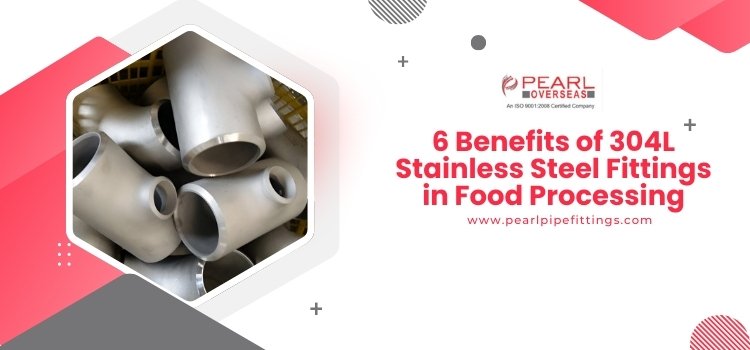
- Readily available as elbows, tees, concentric reducers, and sanitary couplings, alongside matching stainless steel flanges for full pipeline assemblies
- Straightforward to weld, fabricate, and modify on-site
- Integrates well with automated flow-control systems
Welding and Installation Considerations for 304L Sanitary Fittings
Getting the benefits above in practice depends on how the fittings are installed, not just the material choice. Orbital TIG welding is the standard method for sanitary 304L piping, since it produces a consistent, crevice-free internal weld bead that is far easier to clean and inspect than a manual weld. Even with 304L’s resistance to carbide precipitation, welders should still avoid excessive heat input and control interpass temperature to protect the passive chromium-oxide layer near the joint. After welding, passivation (typically a nitric or citric acid treatment) restores and strengthens that protective layer before the fittings go into service. For sizing and weight reference across schedules, our stainless steel pipe fittings weight chart is a useful companion when specifying a full sanitary piping run.
Conclusion
The operational benefits of using 304L stainless steel pipe fittings in food processing are well established. From corrosion protection to hygiene, strength, and regulatory compliance, these fittings provide a dependable solution for sensitive processing environments. For contractors designing food processing plants, specifying 304L, paired with correct orbital welding and passivation practices, supports pipeline safety and performance for the life of the facility.
FAQs
Q1. Why are 304L pipe fittings preferred over standard 304 in food processing?
The “L” in 304L stands for Low Carbon. When standard 304 stainless steel is welded, the heat can cause carbon precipitation, leading to rust around the joints. The low carbon chemistry of 304L reduces this vulnerability, making it better suited for food pipelines that require heavy welding and frequent chemical sanitation.
Q2. Are 304L stainless steel fittings suitable for dairy and beverage applications?
Yes. Because milk and acidic fruit juices are sensitive to bacterial contamination and metal leaching, 304L is a standard choice for dairy pipelines and beverage manufacturing, and it helps preserve product purity and flavor.
Q3. What kind of cleaning systems are compatible with 304L fittings?
304L sanitary fittings are designed to handle rigorous Clean-in-Place (CIP) systems and can withstand boiling water, high-pressure steam, nitric acid, sodium hydroxide, and various commercial chemical sanitizers without corroding.
Q4. What welding method is recommended for 304L sanitary fittings?
Orbital TIG welding is the standard method for sanitary 304L piping, since it produces a consistent, crevice-free internal weld bead that is easier to clean and inspect than manual welding.
Are you looking for reliable, FDA-compliant Stainless Steel 304L Pipe Fittings for Food Processing Applications? Ensure your facility is safe, durable, and up to code. Contact our experts today or email us at export@pearlpipeindia.com to secure the best sanitary piping solutions for your next project.